

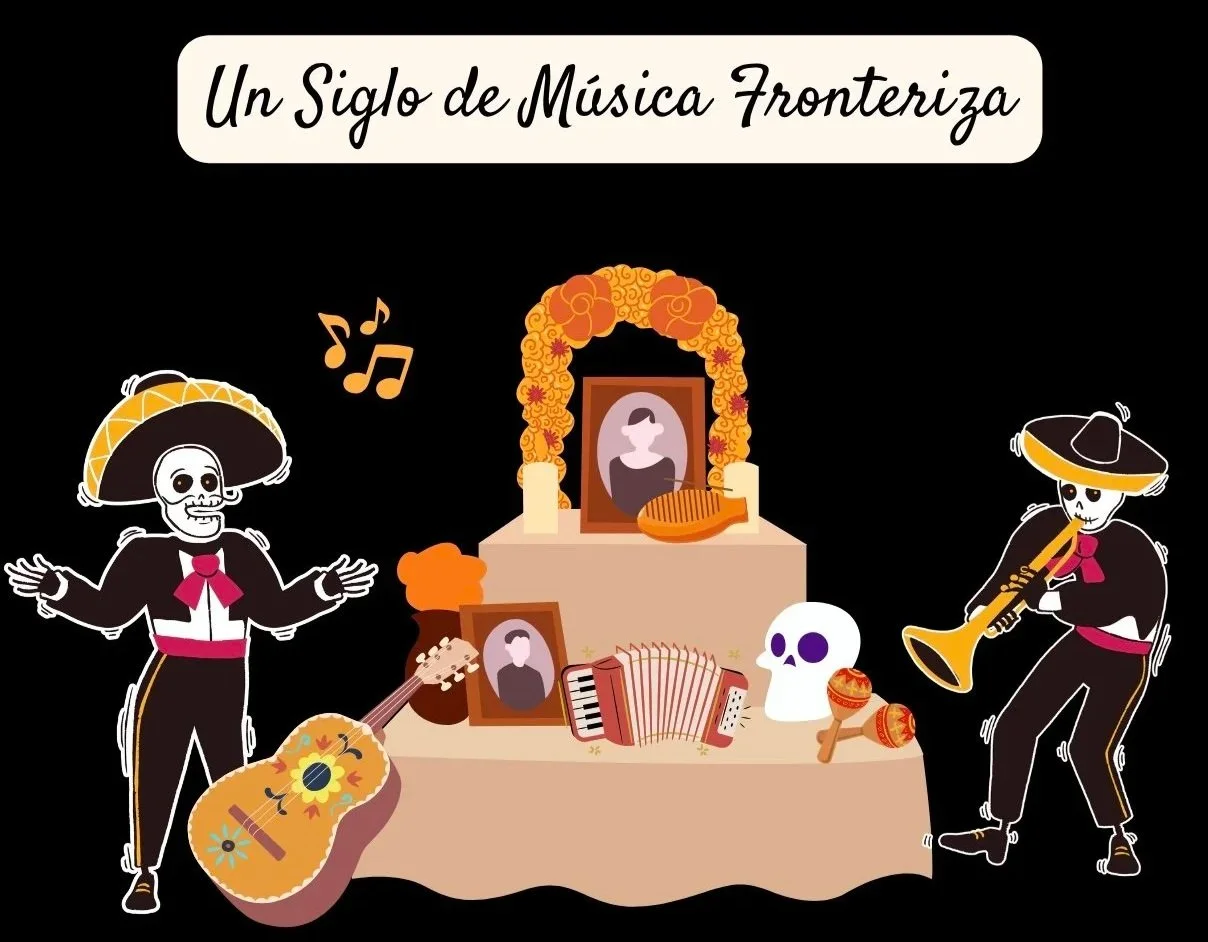
Our altar honors a century of musical voices that have shaped the cultural identity of the U.S.–Mexico borderlands. It celebrates the lives and legacies of border musicians who have passed, recognizing how their music continues to foster identity, resilience, memory, healing, and community across generations.
We invite visitors to reflect on the enduring influence of these artists and the ways music keeps their spirits and stories alive. Music is a powerful vessel for remembrance and connection, making this tribute not only a celebration of artistic legacy, but also an acknowledgment of music’s role in collective memory and cultural continuity.
Click here to listen to the musicians on our ofrenda.
Freddy Fender (1937–2006): Born Baldemar Huerta in San Benito, he was a massive crossover star who topped both the Billboard country and pop charts with hits like "Before the Next Teardrop Falls" and "Wasted Days and Wasted Nights." He later formed the supergroup The Texas Tornados.
Jimmy González (1951–2018): Born in Brownsville, he was the co-founder and lead singer of the iconic, Grammy-winning Tejano group Grupo Mazz. He was a pioneer of the modern Tejano sound.
Laura Canales (1954–2005) was a pioneering Tejano singer born in Kingsville, Texas, widely known as the “Queen of Tejano Music.” She helped pave the way for women in the male-dominated Tejano music industry with popular songs such as “Sí Viví Contigo” and “Dile a Tu Esposa.” Throughout her career, she earned numerous Tejano Music Awards and became one of the first female artists inducted into the Tejano Music Hall of Fame.
Selena Quintanilla (1971–1995): Known as the Queen of Tejano Music, Selena Quintanilla became one of the most influential Mexican American performers of her generation. Raised in Corpus Christi, she brought Tejano music to international audiences and left a lasting legacy of cultural pride, artistic innovation, and representation for Mexican American communities.
Paulino Bernal (1929 - 2022): Born in Raymondville, Texas, Paulino Bernal began his musical career as an accordionist and singer alongside his brother, Eloy. Bernal was best known as a member of Conjunto Bernal, and became known for songs like “Mi Único Camino” and “Sentimiento y Rencor.” Later in his life, Bernal would come to be known as a Christian evangelist. Bernal founded Bego Records, a record label that would help launch the careers of other RGV legendary artists like Ramón Ayala and Cornelio Reyna.
Kris Kristofferson (1936–2024) was an American country music singer, songwriter, and actor born in Brownsville, Texas, in the Rio Grande Valley (956). He was best known for writing iconic songs such as “Me and Bobby McGee,” “Sunday Mornin’ Comin’ Down,” and “Help Me Make It Through the Night.” Throughout his career, he earned multiple Grammy Awards and became one of the most influential figures in country music history.
Rubén Vela (1937–2010): Raised in the Rio Grande Valley communities of Relampago and Mercedes, Rubén Vela became one of the region's most influential conjunto accordionists and bandleaders. His distinctive playing helped lay the groundwork for modern Tejano music while preserving the traditional sounds of South Texas.
Rubén Naranjo (1945–1998): Born in Alice, Texas, Rubén Naranjo was a celebrated conjunto accordionist, vocalist, and bandleader known for his group, Rubén Naranjo y Los Gamblers. His energetic performances and recordings helped carry the conjunto tradition throughout South Texas and established his place in the region's musical history.
Gilberto Pérez Sr. (1935–2021): A longtime Mercedes, Texas, musician, Gilberto Pérez Sr. was a respected conjunto pioneer whose career spanned more than six decades. Through his accordion playing, singing, and performances, he helped preserve the musical traditions that brought South Texas communities together for generations.
Delia Gutierrez Pineda (1931–2023) was a vocalist from Weslaco, Texas. At age 12, she began singing with her father’s Eugenio Gutierrez Orchestra. She performed, recorded, and toured with many musicians, promoting Falcon and Ideal Records with songs including “Pasito Tun Tun,” “Porro, Mi Marianita,” and a Spanish version of “Blue Moon.” She was inducted into the Tejano Roots Hall of Fame in 2002.
Santiago Jiménez Sr. (1913–1984): Known as El Flaco, Santiago Jiménez Sr. was a pioneering conjunto accordionist from San Antonio, Texas, who helped shape the early sound of Texas-Mexican music. His musical legacy continued through his sons, Santiago Jiménez Jr. and Flaco Jiménez, connecting generations of conjunto musicians across the Texas–Mexico borderlands.
Flaco Jiménez (1939–2025): Born Leonardo Jiménez in San Antonio, Texas, Flaco Jiménez became an internationally acclaimed accordionist who brought conjunto music to audiences around the world. Through collaborations with country, rock, and roots musicians, he expanded the reach of South Texas borderland music while honoring the traditions passed down by his father, Santiago Jiménez Sr.
Emilio Navaira (1962–2016): Born in San Antonio, Texas, Emilio Navaira was a celebrated Tejano and country music singer known as the King of Tejano Music. His powerful voice and ability to move between Spanish- and English-language music helped bring Tejano to wider audiences while celebrating the cultural identity of Mexican American communities across Texas.
Johnny Canales (1942–2024): Born in General Treviño, Nuevo León, Mexico, Johnny Canales was a Tejano singer and television host best known for The Johnny Canales Show. His program showcased Tejano and regional Mexican musicians, helped introduce Selena to a wider audience, and became an important platform for Latino artists on both sides of the Texas–Mexico border.
Cornelio Reyna (1940–1997): Born in Parras de la Fuente, Coahuila, Mexico, Cornelio Reyna was a celebrated singer, songwriter, and musician who helped shape norteño and regional Mexican music. As a founding member of Los Relámpagos del Norte alongside Ramón Ayala, he became known for his emotive voice and songs that resonated with working-class communities on both sides of the Texas–Mexico border.
Benny Layton (1943-2023): Born In Edcouch-Elsa, he was a talented accordion player and a champion of conjunto and traditional Tex-Mex folk music. He worked as a dedicated music teacher and public servant, inspiring many local students to pursue music.
Pedro Ayala (1911–1974): Known as El Monarca del Acordeón (The Monarch of the Accordion), Pedro Ayala was a pioneering conjunto musician born in General Terán, Nuevo León, Mexico, who became an influential figure in Texas-Mexican music. His accordion playing and recordings helped shape the conjunto tradition shared across South Texas and northern Mexico, preserving a musical heritage deeply rooted in borderland communities.
Juan Garza Gongora (1934 - 2016) was a singer with The Quarter Notes, a Doo-wop group composed of friends from high school from Laredo, Tx. Their complete versatility is recognized in the way they present "Rock and Roll." "Latin numbers," and "Old Favorites" . They landed a record deal with both Deluxe, Dot & Fox Records reaching a broader audience in English and Spanish of hopeless romantics.
Rene Herrera (1935 - 2005) was a singer and songwriter from Laredo, Tx and with Rene Ornelas created the Latin pop duo “Rene y Rene”. The group scored two hit singles in the U.S. in the 1960s. 1964's "Angelito" ("Little Angel") and 1969's "Lo Mucho que Te Quiero”.
Juanita Garcia (1930–2014) was a vocalist from McAllen, Texas. In 1951, she won a singing contest that led to a recording contract with Falcon Records. Known for her powerful voice and bolero performances, she became especially recognized for her recording of “Llorarás” and her contributions to the musical heritage of South Texas.
Tony de la Rosa (1931-2004) was an influential conjunto accordionist and bandleader from South Texas who helped revolutionize Texas-Mexican dance music. His distinctive accordion style, driving rhythms, and innovative arrangements shaped modern conjunto and influenced generations of musicians throughout the Rio Grande Valley and the borderlands.
Ramiro “Snowball” De La Cruz (1943-2011) was a South Texas musician associated with the Rio Grande Valley’s rich musical heritage. Born in 1943 and raised in South McAllen, he became known for his innovative guitar playing, songwriting, and musical arrangements. He performed with Los Fabulosos 4 and Los Únicos, later forming Snowball & Company with Laura Canales, and was inducted into the Tejano Roots Hall of Fame in 2002.
Valerio Longoria (1924–2000) was an influential Texas-Mexican accordionist, vocalist, and songwriter who helped transform conjunto into a more vocal-centered musical tradition. His innovations influenced generations of musicians and helped establish the expressive singing style heard throughout South Texas and northern Mexico.
Narciso Martínez (1911–1992): Born in Reynosa, Tamaulipas, and closely associated with the Lower Rio Grande Valley, Narciso Martínez was known as El Huracán del Valle. Recognized as the father of Texas-Mexican conjunto, he helped establish the iconic accordion-and-bajo sexto sound that continues to define borderland music.
Santiago Almeida (1911-1999) was a pioneering bajo sexto player whose musical partnership with Narciso Martínez helped establish the foundations of modern conjunto. Together, they recorded some of the earliest influential Texas-Mexican dance music, shaping a sound that crossed the Rio Grande and reached generations of musicians.
Lydia Mendoza (1916–2007): Known as La Alondra de la Frontera, Mendoza performed music that crossed regional and national boundaries while remaining rooted in Mexican American life.
Carlos Guzmán (1940–2024) was a Grammy Award-winning Tejano singer and musician born in Chihuahua, Texas, near Mission in the Rio Grande Valley (956). He rose to fame in the 1960s as the lead singer of Carlos Guzmán y Los Fabulosos Cuatro, best known for their hit song “Vestida de Blanco.” Throughout his career, he recorded over 40 albums, performed alongside legendary artists, and won a Grammy Award in 2001 for Best Tejano Album as part of the group Los Super Seven de Leyendas, leaving a lasting legacy in Tejano music.
Consuelo “Chelo” Silva (1922 - 1988) was a Tejana singer born in Brownsville, Texas, known as “la Reina de los Boleros”. Her distinctive contralto voice alongside her interpretation of the canción romántica style became popular across the U.S. Southwest and Mexico. Chelo’s performances featured coarse language and bold expressions of love lives not publicly common within her community that unfortunately lead to a diminished public memory–as reflected in her having around five official pictures circulating within her active years. Despite this, Chelo maintained her uninhibited performances with a prolific recording career with over 70 tracks and collaborations with other popular artists. She was inducted into the Tejano R.O.O.T.S. Hall of Fame posthumously in 2004.
Steve Jordan (1939–2010): Known as El Parche, Steve Jordan was an innovative South Texas accordionist celebrated for his extraordinary musicianship and experimental approach to conjunto. By incorporating influences from jazz, blues, and other genres, he expanded the possibilities of traditional borderland music.
Arturo Niño (1941–2022) was a South Texas musician remembered for his contributions to the region’s musical heritage. Born in Alamo, Texas, he became known as “El Kromatiko” for his mastery of the chromatic accordion and led the conjunto group Arturo Niño y sus Kromatikos. He was inducted into the Texas Conjunto Music Hall of Fame, leaving a lasting legacy in traditional conjunto music.
Gilberto Garcia (1940–2015) was a legendary conjunto accordionist born in Edinburg, Texas, in the Rio Grande Valley (956). He was best known as the longtime leader of Los Dos Gilbertos, producing conjunto classics such as “El Rosalito,” “La Vieja Escalera,” and “Palabra de Hombre.” Throughout his career, he helped preserve traditional conjunto music, earned multiple Tejano Music Awards, and was inducted into the Texas Conjunto Music Hall of Fame in 2007.
René Sandoval (1936–2022) was a renowned Tejano and jazz musician and saxophonist born in Pharr, Texas, in the Rio Grande Valley (956). He began performing professionally at age 13 and became an influential figure in Texas jazz and Tejano music. Throughout his career, he helped establish the Texas Jazz Festival and was inducted into the Tejano Hall of Fame in 2006, leaving a lasting legacy in South Texas music.
Américo Paredes (1915 - 1999) was a musician, scholar, and folklorist born in Brownsville, Texas. He performed and studied corridos and published articles on how the music form originated within the Mexican-American borderlands and its significance as a narrative ballad. Through his music and work as a scholar, Américo documented the intercultural heritage of the borderlands and challenged biases and stereotypes about Mexican-Americans.
Paulino Bernal (1939–2022): Born in Raymondville, Texas, Paulino Bernal was a pioneering accordionist, singer, and co-founder of Conjunto Bernal alongside his brother Eloy. His innovative playing helped transform conjunto music across South Texas and northern Mexico, and he later dedicated his life to Christian music and ministry while continuing to share his musical talents with the community.
Arnaldo Villarreal Ramírez (1918–1993): Born in Mission, Texas, Arnaldo Villarreal Ramírez, known as “Mr. Falcon,” founded Falcon Records in 1948 and became a pioneering force in Tejano and conjunto music. Through his recording label, radio programs, and Fanfarria Falcón television show, he helped introduce Mexican American and regional Mexican musicians to audiences across the United States and Mexico, preserving the musical heritage of the Rio Grande Valley.
Jake Cortez (1976–2021): Born in Weslaco, Texas, and based in McAllen, Jake Cortez was a guitarist, singer, songwriter, studio musician, and private instructor known for his distinctive blend of flamenco, blues, rock, jazz, and classical music. Influenced by his father's Mexican folk music, he developed a unique musical voice that reflected the creativity and cultural diversity of the Rio Grande Valley.